













Manchester City have secured Allan Elias from Palmeiras, and supporters can be forgiven for knowing considerably less about him than some of Brazil’s other recent exports.
The 22-year-old didn’t arrive with anything like the hype surrounding Endrick or Estêvão. In fact, his route into the Palmeiras first team was almost the opposite.
Allan had to work his way through every stage of the academy. There was even talk of sending him out on loan before his senior breakthrough.
A little over a year later, Manchester City have committed €37.5m (£32.4m) plus €2.5m (£2.2m) in easily achievable bonuses to sign him.
So, what exactly are City getting?
From overlooked youngster to key Palmeiras player
Allan started playing futsal in Santa Catarina state at seven and joined Figueirense at 14. Palmeiras spotted him at a tournament in Minas Gerais state and bought him in February 2019.
His progress wasn’t spectacularly quick from there. Of course Palmeiras have become used to teenagers jumping straight from their academy into major European transfers. But Allan was different.
He wore the number ten for their U20s in 2024, scoring 17 goals and adding four assists. Even then, a loan was considered.
At the start of 2025, Allan wasn’t among the academy players initially expected to join Abel Ferreira’s senior squad. His performances shortly changed that.
Abel had watched him closely and eventually decided he wanted Allan around the first team.
“I thought he was skinny and slight, but he isn’t. He’s very well built,” the manager said early in 2025.
Abel also highlighted something which would become increasingly important. “He can play as a number eight, attacking midfielder or winger.”
From being an extra addition to the senior group, Allan eventually became difficult to leave out.
Two nights when everything clicked
If Manchester City supporters want examples to understand why Allan’s reputation took off, their 4-0 win over LDU in 2025 is a good place to start. He was a Brighton target back then.
Palmeiras needed a huge comeback in their Libertadores semi-final. Allan started after nine consecutive appearances from the bench and produced arguably his defining performance for the club.
He registered an assist and later ran through the LDU defence with a brilliant individual move. That ended with Allan winning the penalty converted by Raphael Veiga.
Palmeiras completed their comeback and reached the final. Abel was delighted.
“He has incredible ability to unbalance opponents and incredible verticality,” he said afterwards.
There was another big night in 2026, this time at the Maracanã. Palmeiras arrived to face Flamengo under pressure after three consecutive league draws and a Libertadores defeat.
They were also facing a side they hadn’t beaten at the Maracanã for almost 11 years. Allan helped change that.
Allan set up Flaco López for the opener and then scored the second himself. His goal was a slightly unusual one – he finished with his shoulder after continuing his run into the box.
Palmeiras eventually won 3-0 and moved seven points clear of Flamengo at the top of the table. It was another example of Allan producing when the occasion was big.
By that stage, Allan had gone beyond being an exciting option from the bench. He was a regular, and his role continued changing.
So where does Allan actually play?
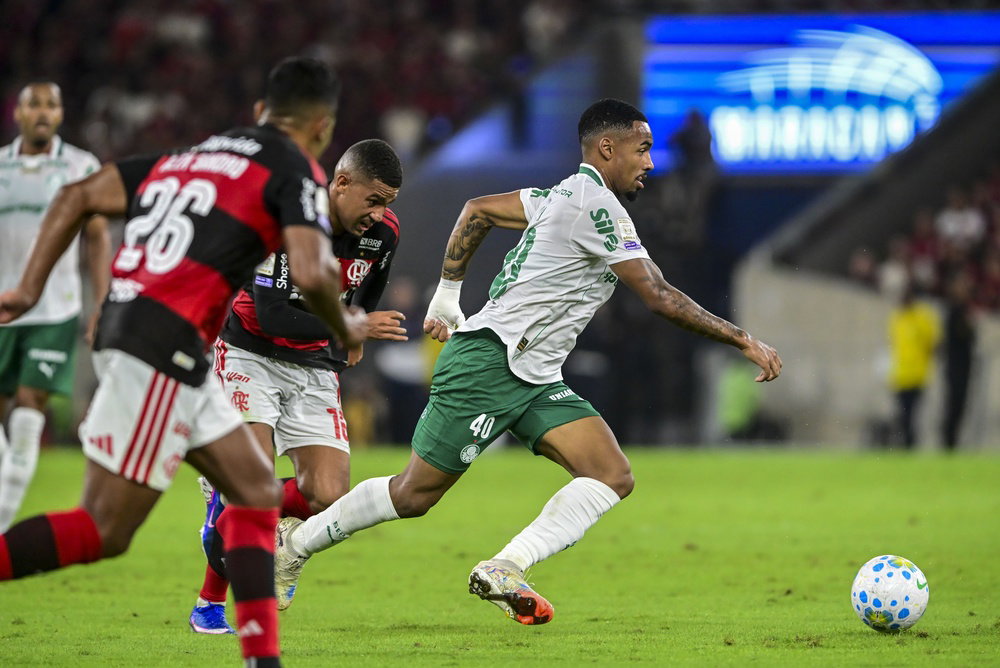
Calling Allan Elias a right winger is probably the easiest answer. But it isn’t really the complete one.
He can receive wide, attack his full-back and carry the ball at speed. His close control also allows him to beat opponents in tighter areas.
The acceleration immediately stands out. Allan wants to go forward when he receives possession. He can carry the ball through transitions and is comfortable attacking defenders one against one.
There’s end product too. He leaves Palmeiras with nine goals and 12 assists from 96 senior appearances.
Yet what really attracted praise from Abel was everything happening around those attacking qualities. During 2026, Palmeiras used Allan as a right wing-back in a three-centre-back system.
That demanded a lot physically. He had to attack the entire flank, recover defensively, press opponents and repeatedly make the same runs throughout matches.
As we covered earlier, Abel believes that’s what separates him from most Brazilian wide players.
“These teams want a player like Allan because he does what 90% of the wingers here can’t do, which is attack and defend along the entire flank.”
The Palmeiras manager has also used him at right-back. Allan can operate outside a back three and move inside to combine with teammates. And earlier in his development, Abel even saw him as capable of playing in central midfield.
Fair to say Manchester City will have plenty to work with.
More than a dribbler
There’s a temptation with young Brazilian attackers to focus almost entirely on tricks, dribbles and highlights. Allan is very technical and can certainly provides those.
His speed and directness can make him great fun to watch when he gets space. His ability to beat a defender can change a game very quickly. He’s an excellent 1v1 player and has an outrageous phisicality to support his runs.
But his work without the ball became just as important at Palmeiras. He presses, tracks runners and gets back into defensive positions. He also has the engine to repeat those actions. That versatility helped Abel change his own system.
Allan could provide width when Palmeiras had possession and effectively become part of the defensive structure when they lost it. It explains why Abel wasn’t particularly happy about losing him.
He had previously joked that Palmeiras didn’t need to sell any more players. Once City’s interest became serious, the manager made his valuation very clear.
“If they want this type of player, they’ll have to pay €100m (£86.5m),” he said.
City haven’t gone anywhere near that figure, of course. They have still made Allan one of Palmeiras’ latest major academy sales.
A very different rise
The speed of Allan’s development is perhaps best illustrated by what Palmeiras did with his economic rights.
Before the 2025 Club World Cup, they owned 70%. They paid Figueirense around €267k (£231k) for another 20%, effectively valuing the player’s total rights at around €1.33m (£1.15m).
Globo Esporte calculates his subsequent sale represents a 2,900% increase in valuation. That didn’t come after years as Brazil’s next superstar. It happened because Allan kept earning a bigger role.
He went from a player Palmeiras might loan out to someone Abel built part of his system around. Now Manchester City have the next part of the job.
They are getting a quick, direct and technically gifted player who loves taking defenders on. They’re also getting someone who has already learned to do plenty of the less glamorous work.