


















Tottenham’s pitch has had its fair share of criticism over the past few years.
Whenever another injury crisis hits Spurs, it doesn’t take long for the playing surface to be dragged into the discussion.
That argument is always there for debate. Even if plenty of Tottenham’s injuries have happened away from home, while others have had little direct connection to the surface.
Still, what goes into keeping the pitch at the Tottenham Hotspur Stadium ready for Premier League football is quite something.
How Tottenham protect the football pitch
Gabriel Faleri, a Brazilian who works for Sheep Tech, the company involved in Tottenham’s pitch logistics, has explained how the whole operation works to ESPN Brazil.
Faleri said he had looked at the numbers since starting work there in 2023.
“Since I joined Tottenham in 2023, I actually did some research into this. On average, the stadium hosts around 35 to 45 events per year, and only about 27 of those are football matches.”
“Tottenham have an entire system designed so that only football matches take place on the football pitch. Events like boxing, NFL games, concerts and anything else use a different surface or floor.”
“Concerts require a specific set-up, while the NFL and other events use another pitch or surface.”
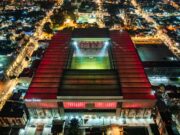
As you may know, Spurs’ natural football pitch is retractable. It can be divided into sections and moved underneath the stands, protecting it while another surface is used inside the stadium.
“So, for example, if you look at the pitch used for Premier League matches, it has a certain structure and level to it. The NFL surface and the surfaces used for other events are flatter.”
“There’s an electronic mechanism, almost like a huge crank system, which allows them to move the football pitch underneath the stands when the stadium is hosting concerts or NFL matches.”
Keeping it alive isn’t cheap
Of course, having that technology is only part of the job. The grass still needs looking after, particularly given the English climate and the demands of elite football.
According to Faleri, Tottenham spend serious money every year just keeping the operation going. He took a deep dive in those.
“Just the artificial lighting used for the grass – the grow lights – costs somewhere around £400,000 to £600,000 per year. Then the undersoil heating costs an estimated £150,000 per year.”
“Replacing the pitch annually costs around £150,000 to £350,000, and then you’ve got fertiliser, water and everything else, which comes to another £50,000 to £80,000 per year.”
“That’s before you even include the external team hired to make the whole operation work. So we can say with some confidence that they’re spending around £1m a year, or more, just on maintaining all of this.”
The stadium itself reportedly cost close to £1bn, so Tottenham clearly built it with this multi-purpose operation in mind.
Timing also matters of course. Faleri says the vast majority of concerts are deliberately kept away from the football season.
“Concerts usually happen in the summer. Most of them take place when the football season isn’t running. There are exceptions, but it’s rare for concerts to happen during the season.”
“At least 90% of them take place outside the football season, usually between May and September, and generally in the summer.”
Why there has to be a limit
One of the most interesting part comes when Faleri talks about how much football a pitch can realistically handle. Tottenham have technology, money and specialist staff. Even with all that, there are physical limits to how quickly grass can recover.
Faleri was presented with the prospect of a stadium hosting around 72 matches in a year. His response was pretty emphatic.
“When you talk about something like 72 matches per year, though, it’s basically impossible.”
“There isn’t a team, a technology or a group of people capable of properly maintaining a pitch under that kind of schedule. You’re talking about 72 fixtures in a year.”
“That basically means Wednesday-Sunday, Wednesday-Sunday, Wednesday-Sunday, over and over again. And that’s before you even take holidays and breaks into account.”
“There simply isn’t enough time for the pitch to recover. There isn’t enough time to carry out mitigation work. And there isn’t enough time for the grass to regenerate, because the wear from people constantly running and walking over it – effectively trampling it – so requires recovery time.”
“If you’re talking about 72 matches there, plus events and concerts, it’s extremely difficult. Even if you’re putting down protective EVA flooring and other materials, it never protects the surface completely.”
In the end, what Faleri’s explanation does show is the amount of work Tottenham put into separating football from everything else happening at their ground.
For a stadium hosting as many different events as Tottenham’s does, protecting those few dozen football matches is quite an operation in itself.